


![[Translate to Englisch:] August Macke Signatur](/assets/content/0_signatur_macke.jpg)
LIFE AND WORK
AUGUST MACKE 1887–1914
August Macke ranks among the most important pioneering artists of the early 20th century. He tirelessly experimented with forms and colours in his search for a new artistic language. The well-read and open-minded young man sought an artistic form of expression that would do justice to the revolutionary achievements in the fields of science and the humanities. In doing so, Macke acted independently of bourgeois conventions and the prevailing conservative view of art. French modernism in particular became his most important source of inspiration.
I. Balance on the edge of the abyss
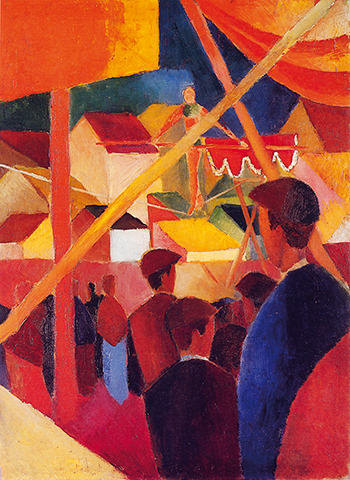
In 1914, during his final year of creative work, the 27-year-old August Macke painted a picture of a tightrope walker. The impression of a variety show on the market square in Thun (Switzerland) becomes a parable of the modern artist. Experience and imagination merge into a new reality. The artist acts in a downright daring manner, balancing far above the heads of the spectators at the height of the gables of the houses above the market square. The figure of the tightrope walker symbolises the fragile social situation of the modern artist, who moves away from official paths and conventions. Thus, the tightrope walker also represents August Macke himself. Today, Macke is one of the most popular artists of the first half of the 20th century. He is considered a cheerful, accessible expressionist. Paintings from his important periods of work fetch prices of over 2 million euros at auctions. During his lifetime, however, there was little sign of this enthusiasm. Contemporary viewers imagine something completely different when they think of art, and it is precisely the unusual colourfulness that is met with great incomprehension. With his new painting style, Macke runs the risk of losing his livelihood at any moment – just like the tightrope walker in his painting. Against the backdrop of the German Empire and its strict social norms, Macke's life and artistic development prove to be a consistent but also repeatedly arduous path. At the turn of the century, many European artists find themselves in the same situation. Artists and jugglers serve as metaphors not only in art but also in literature for the ambivalent predicament between flights of genius and existential danger.

II. Education, artistic beginnings
August Robert Ludwig Macke was born on 3 January 1887 in the small town of Meschede in the province of Westphalia. His two sisters, Auguste and Ottilie, were many years older than him. His father was a self-employed building contractor and his mother came from a farming background. Macke grew up in Cologne and then in Bonn. His childhood was overshadowed by the financial difficulties of his father's company. Even as a schoolboy, Macke had only drawing on his mind and played a key role in designing the sets for school plays. Against his father's wishes, he dropped out of school at the age of 17 to become an artist and began studying at the renowned Düsseldorf Art Academy. His professors considered the young student to be exceptionally talented. However, the conservative training concept did not correspond to Macke's ideas at all. Painting historical pictures depicting significant events from history or the present day was still considered the highest goal of academic training, as it had been for centuries. The same applied to the technical perfection of drawing in order to create as accurate a representation of reality as possible. All of this had little in common with the innovations of his own time. Macke sought other sources of inspiration for his art: in books, in the art magazines that were appearing in increasing numbers on the market, in exhibitions and in nature itself. In his early paintings, nature conveys mood and meaning, symbolising his very personal feelings. The shape of a tree, the movement of waves in the water, the harmony between man and nature, and the restrained colouring underline the romantic mood and the proximity to symbolism.
III. French Impressionism as a source of inspiration – trips to Paris
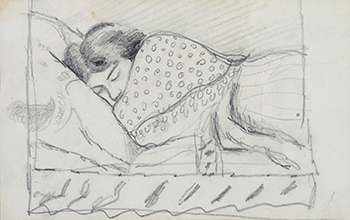
Macke gained even more exciting impressions at the Düsseldorf School of Arts and Crafts, where he took evening classes. Reformist ideas had already found their way into this training centre for future artisans. Macke also gained practical experience at the Düsseldorf Theatre. The newly founded theatre became a reform stage thanks to its lively performances of modern plays. As a set and costume designer, Macke played a decisive role in their implementation. ‘I would create moods through curtains and colours alone, without imitating nature,’ he said, expressing his revolutionary ideas. He felt that the path he had taken so far was a dead end. He gave up his academy training and also turned down the permanent position as stage designer that had been offered to him. This required a great deal of courage and a good dose of self-confidence. He wanted to be free from external constraints and develop his own artistic language, even if this meant taking a big risk, not only financially. When he saw photographs of paintings by French Impressionists in 1907, they opened up a whole new world for him – even though they were only black-and-white prints. It was the focus on the reality of life and the completely new painting style that fascinated him about these pictures. And so he had nothing more urgent to do than to travel directly to Paris, the Mecca of modern art. Like so many of his young contemporaries who were disappointed by the academy, he let the originals of the paintings in the art galleries of Durand-Ruel, Vollard and Bernheim-Jeune work their magic on him. The Café du Dôme even became a meeting place for all those seeking inspiration, for artists, gallery owners and collectors. Macke learned to see in a new way and turned to Impressionist light painting. On two further trips to Paris in 1908 and 1909, he consolidated his engagement with modernism.

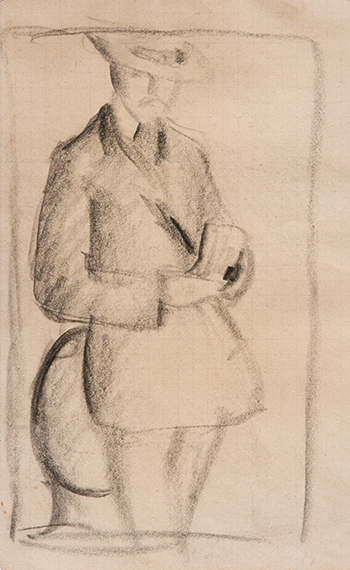
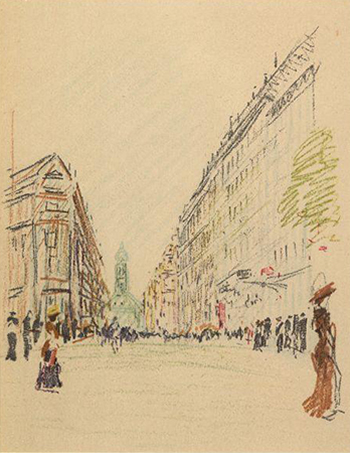
Sigh, Paris is surely the loveliest city in the world. […] I‘m becoming fonder and fonder of the impressionists.
August Macke 1907 from Paris
I‘m now more convinced than ever of the quality of the French School.
August Macke 1910
IV. Colorful Worlds with Fauvist Influences
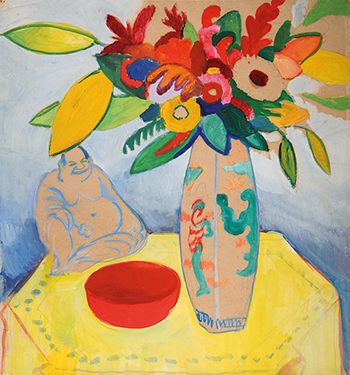
Impressionism and Japonism, for which Macke was also enthusiastic, freed him from tradition. Nevertheless, he sensed that this was not the end point of his artistic development. After completing his year of military service, a new chapter of his life and a new artistic phase began. In 1909, he married his childhood sweetheart, Elisabeth Gerhardt. Due to her premarital pregnancy—a scandal at the time—the young couple withdrew from Bonn and even considered settling in Paris. However, the rents were too high, so they ultimately chose Tegernsee near Munich. Elisabeth was his muse, model, and, as Macke himself wrote, his "second self." His surroundings and everyday household objects, arranged in the living room due to the lack of a studio, also found their way into his pictorial worlds. The colors radiated across the canvas and began to take on a life of their own. The viewer was confronted with a decorative overall harmony, with colored outlines and unusual perspectives. The influence of the French Fauvists, the modern art movement around Henri Matisse in Paris, is evident, and their works fascinated Macke in Munich in February 1910. But another exhibition also had a significant impact: the "Exhibition of Masterpieces of Islamic Art," for which Henri Matisse traveled from Paris to Munich. Evidence of foreign cultures inspired modern artists at the beginning of the 20th century, as did a conception of art far removed from European tradition. Around 1910, the term "Expressionism" was coined for this new style, precisely defining its contrast to Impressionism.
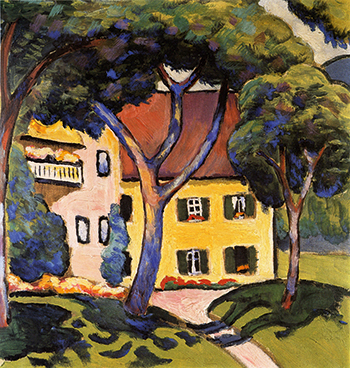
The offer of his own studio, built entirely according to his own specifications, prompted August Macke, along with his wife Elisabeth and young son Walter, to return from Tegernsee to his old home in Bonn at the end of 1910. His mother-in-law provided them with a small, late-classical house on the edge of her Gerhardt factory grounds, the attic of which was converted into a spacious studio according to Macke's plans. Until Macke's conscription into military service on August 2, 1914, his new home served as the hub of his diverse artistic and political activities. Artist friends such as Robert Delaunay, Max Ernst, and many others were frequent visitors. Numerous of his most famous paintings were created in the bright attic studio, and during a visit from Franz Marc in 1912, the two painted a large paradise scene on a four-meter-high wall there. The adjacent large garden was the children's playground and an important subject in his paintings.
V. National and International Networks – The Artistic Friendship Between August Macke and Robert Delaunay
The modern styles influenced by the French avant-garde, along with the artists, their gallerists, and collectors, not only aroused disapproval in Wilhelmine Germany but also made them suspect of pandering to its hereditary enemy, France. The press labeled Expressionist artists like August Macke and their work "mad," "mentally ill," or "degenerate." Excluded from official exhibition opportunities, they had to take the marketing of their works into their own hands and founded independent associations. Between 1911 and 1913, Macke became a significant driving force in art politics and a gifted networker in the Rhineland, Munich, and Berlin. Rhetorically skilled, extroverted, and with a captivating personality, he forged connections, organized exhibitions, and gave lectures. “He can do incredibly fine advertising and is skillful in his public appearance,” remarked the Russian colleague Wassily Kandinsky (1866–1944) approvingly. New buyer groups needed to be tapped, but above all, it was essential to foster an understanding of modern art. To this end, German modern artists networked with each other, but also across national borders. Close contacts existed not only with Russia, Switzerland, and Scandinavia, but especially with France and Paris. Macke befriended Robert Delaunay, whom he visited in his Paris studio in 1912 together with Franz Marc. In January 1913, Delaunay and Guillaume Apollinaire stopped in Bonn to visit Macke. From then on, the two artists regularly exchanged ideas about art and personal matters, working together on the international integration of modernism. Delaunay was repeatedly invited to exhibit his modern paintings at the avant-garde art exhibitions organized by August Macke and his artist friends, including the traveling exhibition of the Blue Rider group (1911/12) and the legendary First German Autumn Salon in Berlin (1913). The Berlin patron Bernhard Koehler, uncle of Macke's wife and one of the few who collects "living art," financially supports Macke and his friends in their exhibition and book projects. He is also Macke's most enthusiastic buyer. And: he acquires two paintings by Robert Delaunay for his collection.

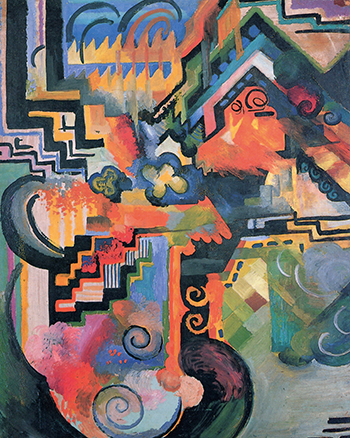

An artwork must be a good fabrication of nature, a selection well made, a mirror of sensations.
August Macke around 1912
VI. Cubist and futurist styles open up new possibilities
Industrialization and technical inventions are changing the look of cities and people‘s everyday lives. Around 1911 Macke looks for new artistic means of visually documenting this transformation. He finds inspiration in the French and Italian avant-garde: in the cubists and futurists. On a trip to Paris with artist friend Franz Marc he sees their work at art dealers such as Vollard. And works of Georges Braque, Pablo Picasso and the futurists are also being shown in various small gallery exhibits in Germany. In his own drawings and paintings Macke then uses stylistic means such as the fracturing of object forms into individual parts; simplification of objects to lines; rhythmic repetition of forms; and small, chopped, geometric snippets. While simultaneously showing quick- paced, clamorous, and pulsating hectic along with technical advances, this lets him illustrate movement as an almost abstract pattern or as an environment that seems to collapse upon his figures. Numerous one-man shows and participations in exhibitions in 1912 and 1913 demonstrate that the open-minded art scene welcomes his work. But Macke is frustrated that his works are not selling: “By the way, with what I earn from painting, it would be better just to sit around and do nothing.” Endurance is required to ignore repeated hostility, bear up against traditional attitudes, and confidently continue along his artistic path, particularly since Macke has to contribute his share to supporting the family with two small sons. Monthly stipends from his wife‘s wealthy relatives cover only basics. But he remains self-assured: “What others think about my pictures no longer interests me.”
VII. Handicrafts as Part of Everyday Living
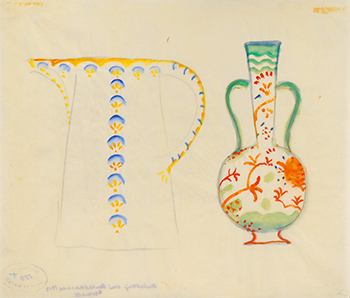
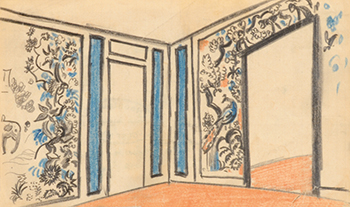
For Macke, art and handicrafts are a “form of living” and belong together. An important goal of the expressionists is to design living environments as total works of art in accordance with their own modern ideas. In his bright studio in Bonn with its large skylights Macke works not only at the easel but also at the carpenter‘s bench. He paints porcelain and drafts scenes for needlework that he often sketches directly onto the textile. Macke made his first drawing for embroidery as early as 1905 — out of dissatisfaction with old-fashioned motifs. His wife Elisabeth and her mother and grandmother do the embroidering. At a talk given by Macke, Elisabeth even wears a modern reform dress modeled after his sketches. Moreover, Macke designs door fittings, cabinet attachments, and jewelry, and makes furniture, cushions, and rugs for private use. But the goal is for modern-designed products to replace traditional and out-of-date patterns in the commercial sector as well. The main objective is to restore Germany‘s reputation, which had been tarnished in the 19th century because of products‘ inferior quality and antiquated appearance. Inspired by the reform movement of the “Deutscher Werkbund”, Macke prepares drafts in 1912 of functional modern design for everyday tableware manufactured for export markets. “I‘m doing porcelain now,” he writes to his patron in Berlin. He builds a reputation as designer and in 1913 is asked to draft the concept for the interior decoration of a tea salon in Cologne. Color sketches and numerous drafts give us an idea of Macke‘s design scheme which, however, is never implemented owing to the outbreak of the First World War.
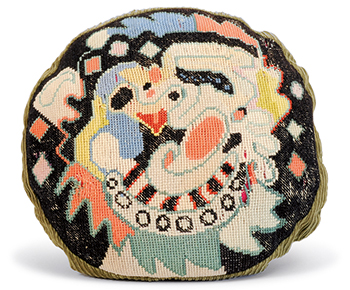
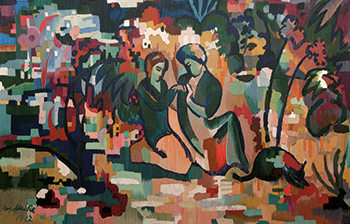
The work of art is a simile of nature, not a reproduction. […] it is the thought, the independent thought of a person, a song on the beauty of things.
August Macke 1913
VIII. Earthly Paradise
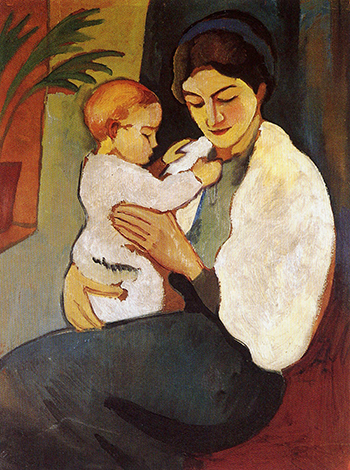
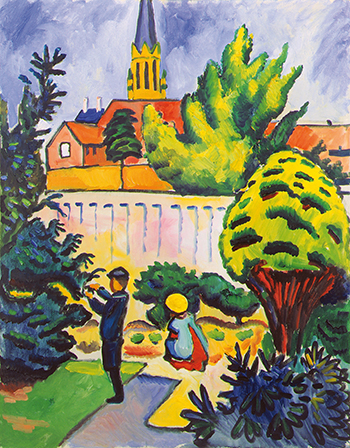
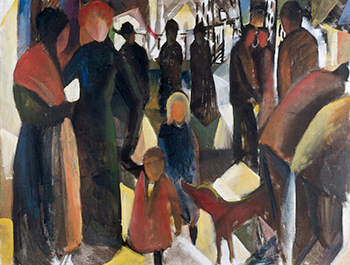
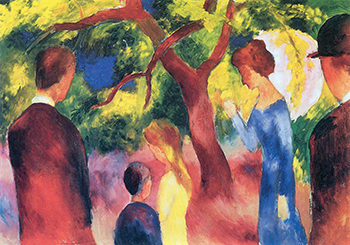
Macke sees happiness as living in the circle of the family with his wife and two sons, and he defines art and living as “instilling joy into nature.“ This positive outlook, particularly in Macke‘s years in Bonn from 1911 to 1913, takes on a characteristic accent that feeds into his art. The images in Macke‘s compositions show variations and multifaceted representations of an earthly paradise. His works become visions of a world in harmony. And, as “songs on beauty” (Macke), they are simultaneously counter-concepts that stand in opposition to an age marked by technical innovation and industrialization. While the great International Expositions of the 19th century in Paris and London identified the South Seas and the Orient as distant places of yearning, Macke locates his earthly paradise in the here-and-now of the real world. All turbulent, destructive, and negative elements are banished. The garden appears as a place of leisure and comfort, as an earthly idyll. And just like his scenes depicting lovers and family, the people and animals in Macke‘s zoological garden pictures are also rendered as a harmonious and primal unity. The peaceful togetherness of the married couple that is reflected in Macke‘s pictures, as well as their mutual care and respect, are not always to be expected in middle-class circles of the time. To typify the close bond between the pair, he introduces crouching figures as a new form-vocabulary borrowed from the Orient. In intimate scenes of everyday life, Macke shows us the world of children who appear naturally and unselfconsciously engrossed in play. The parent-child relationship is redefined here, in accordance with a reform pedagogy that no longer regards children as decorative accessories.
IX. Artistic Synthesis
To devote himself once again entirely to art without the distraction of behind-the-scene art politics, Macke and his wife and two sons depart from the Rhineland‘s hustle-bustle in October 1913. They take up residence on Lake Thun in Swiss Oberhofen for eight months. Rosengarten House, where the apartment is located, stands lakeside opposite an impressive panorama of Swiss Alps. Inspired by the “sunlight flooding through the windowpanes” (Macke) in the paintings of Robert Delaunay, he develops his own unique art philosophy shortly before the outbreak of the First World War. Nature remains his compass as experienced reality, but he now alters and combines motifs. By assembling individual forms into a painted collage, new image-worlds emerge in keeping with his ideas. While appearing to be realistic, they are imaginary. In Macke‘s shop-window pictures the influence of his friend Robert Delaunay can clearly be seen both in terms of motifs and in the prism-like fragment- ation of form and color. But Macke translates the abstractions of the French artist into a contemplative and buoyant image-world. Since dull shades of gray largely predominate in real-world facades and street scenes, the chromatic freshness in Macke‘s pictures is to be interpreted as a metaphor. The legendary trip to Tunis undertaken in April 1914 by Macke with his friends Paul Klee and Louis Moilliet lasts fourteen days. The sunlight of southern shores, the exotic motifs — the artists feel they are living in a fairytale. Macke writes: “I‘m producing like the devil and feel a joy in working that I‘ve never known.” He brings home countless sketches, watercolors, and photographs, which he utilizes later on in the studio in Bonn.
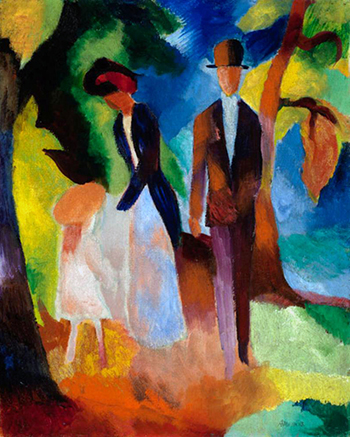
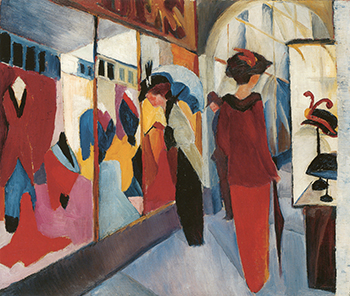
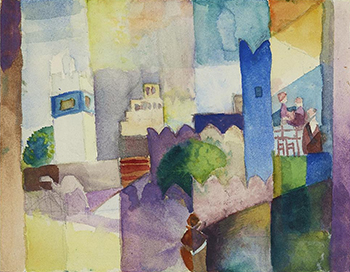
Our most welcome objective is to unlock the spatially defining energies of color rather than contenting ourselves with somber light-dark effects.
August Macke 1913
War is a thing of indescribable sadness.
August Macke 1913
X. First World War
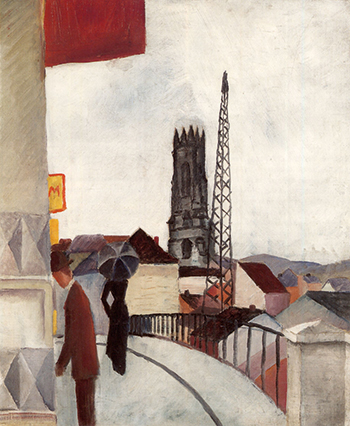
After returning to Bonn in the summer of 1914 Macke produces his most famous pictures in a burst of creativity. The artist sees it as his respon-sibility to help shape modernism by means of a new esthetic and paints motifs such as children against the backdrop of an industrial harbor landscape, or a modern iron lattice tower positioned alongside an ancient gothic cathedral. These are less a display of the negative consequences of progress or a sign of isolation and alienation than they are a statement of new possibilities. When Austria declares war on Serbia at the end of July 1914 in the wake of the assassination of the heir to the Austro-Hungarian throne, Macke senses the oncoming end of an era and the approaching rupture of his artistic efforts. There is no avoiding the immediate call-up into the army after the German Empire orders mobilization on 2 August 1914 — Macke is a trained reservist in the rank of sergeant. At first a certain degree of enthusiasm can be felt — despite the close friendships and ties to French and Russian artist colleagues. Hopes are that the War might sweep away the encrusted past and finally make room for a new beginning. But after the first major battle, Macke is completely disillusioned. Euphoria yields to despair in view of “the horror.” Macke is killed in Perthes-lès-Hurles in Champagne on 26 September 1914, just seven weeks after the outbreak of hostilities. On the easel in his studio a somber looking painting remains unfinished. After Macke‘s death Elisabeth is left with their two little sons. She has not only lost the love of her life, she must also look after her young family. In addition, the burden of administering her husband‘s artistic legacy now rests on her shoulders. In a powerful and moving memorial Macke‘s friend Franz Marc bewails the irreplaceable loss to German art: “With his death one of the most promising and daring lines of development of our German art has been abruptly severed; none of us are capable of carrying it forward.” Two years later Marc too is killed on the battlefield.
XI. Aftermath
The esteem for August Macke among modernist artist colleagues is enormous. But only few collectors actually purchase his paintings. The only exception is Bernhard Koehler, who owns more than 50 works by Macke alone. Not a single museum has acquired one of his paintings during his lifetime. The artist has given away many of his paintings as gifts in gratitude to collectors or for the organization of exhibitions. The appreciation of expressionist art does not begin until after the First World War. The artists for whom no understanding was previously shown are now appointed as professors at the art academies which have finally been reformed. And Macke‘s pictures now enter the in- ventories of the museums. But only for a short time, for these works are removed from the public collections and confiscated by National Socialists as part of the “Degenerate Art” campaign in 1937/38 and the traveling exhibition of the same name. To generate hard currency, the National Socialists order the auctioning off in Switzerland of artworks they classify as “degenerate” or their sale by a specially commissioned art dealer. After the Second World War the museums must rebuild their holdings of expressionist art. The fate of many pictures remains unknown, some occasionally resurface on art markets. Macke‘s art begins to undergo a process of reappraisal and his work increases in value, above all in the 1990s. Macke exhibitions are genuine blockbusters nowadays. Paintings from his final years of creativity prior to the First World War, the “typical Mackes” that have meanwhile entered into the public‘s collective memory and become part of many households through purchases in museum shops as prints on mugs and in calendars, now fetch prices on the art market that exceed millions and can hardly be paid by publicly financed museums.
Text: Ina Ewers-Schultz
[…] the rhythmic elements in art are a simile of those in nature itself.
August Macke 1913